The Springs of the Holy Mountain
The sound of a rivulet had begun to fill the gorge. If one stopped to look up, one saw that the path had entered under branches of overhanging trees. Another path branched off to climb the steep ridge to the right. Looking backward, one saw the valley widen down toward the sea, with the walls of the Holy Monastery of Grigoriou perched on a rock at the base of the mountain that would lead up at last, if one had strength to follow the ridges, to the great peak of Athos.
We stood, then, in a glade in the garden of the Theotokos.
But one could not stop to look up, except to catch breath. The stony path was too precarious and uneven. All one’s attention was on the next step.
We had been climbing for almost an hour. Father Modestus had assured us that the elder’s cell was only an hour from the monastery. But he was used to walking these paths. It was an arduous climb for us, steep with switch-backs. At times, the path was almost eroded by landslides. One had to step cautiously to avoid a precipitous slide down the slope. The views, of course, were astounding, view upon view, at every turn changing; but there was no time for the view. We need to get to the elder’s cell our questions, and still get back to the monastery in time to catch the boat for the Athonite port of Daphne. We had started at first light. A strong breeze had developed during the night, and clouds had crept out of the curtains of darkness before dawn, removing the oppressive heat and making the morning pleasant.
At the bottom of the gorge, it widened under the walls of the monastery into a narrow plain. This was filled with gardens and, strangely enough, wide roads terminating in a cement plant for the monastery’s ambitious construction projects. These were most notable at the docks, which were new and complex, with bays and boat launches and roads for large vehicles to be driven up to the monastery gates.
But there was no water in the bottom of that valley, not at this season just past midsummer.
Fr. Modestus had pointed out the immense new concrete cistern. The old one next to it was no longer large enough for the water needs of the number of pilgrims who now come.
Just past the new cistern, the rivulet’s course narrowed. One could see that in the rainy seasons it would be a torrent, but now it was dry. A new concrete bridge crossed over and stood along and empty with no connecting road on either side. Obviously, a new road was planned here.
Fr. Modestus lamented the scale of construction all over the Holy Mountain. This area, where the gorge widened into a valley, had been a meadow with wildflowers, butterflies and dragonflies everywhere. Now it was a construction site with bare dirt, rubble and equipment, and wildflowers can no longer be found. They have to grow roses in their own gardens to put around the icons at the feasts. Especially the new roads for cars, he said, are destructive to the ancient footpaths, often wiping them out entirely. He insisted that the footpaths are the only way to experience the Holy Mountain.
A large plastic pipe ran above the stream bed and dived into the side of the old cistern. As we climbed alongside the narrowing gorge, we could see that this pipe maintained a gradual slope above it, supported on concrete piers, some quite tall, like an aqueduct. This kind of construction on a smaller scale, said Fr. Modestus, was more appropriate for Mount Athos The elder toward whom we were now climbing, he told us, himself had overseen the construction of this aqueduct thirty years before.
The springs of Mt. Athos give an abundance of pure water. Because of the thickness of undergrowth, we were no longer within sight of what waters had emerged within the gorge; but we could now hear their melodies.
We were approaching their source. We were climbing toward the solitary dwelling of one who had harvested their life-giving sweetness for the sake of his monastery. We dared to attempt this path toward an elder who, late in his life, had withdrawn into hesychia – into the life-giving source of pure, sweet prayer.
“The life of a hermit is the hardest life of all,” said Fr. Modestus. “It is best not to disturb such a one unless you have a specific question that really needs an answer. We benefit far more from their prayer.”
I had insisted, however, that Fr. Nicholas take advantage of this opportunity to approach an elder of hesychastic prayer. And since he, in turn, suggested that Scott and I might want to ask something, we were bold enough to tag along.
The path turned into the stream bed. It was shallow, but full and swift. We crossed it on stepping stones and made the turn that led out onto the ridge above the opposite side of the gorge. Emerging from the forest, we came out onto an open area far above the monastery and the sea, at the gate to the elder’s cell.
A monk was just leaving, climbing the shady ridge above. A pleasant garden was spread in front of the cell. Fr. Modestus informed us that St. Hilarion of Georgia had lived in this cell, as had another saint.
The elder took us into the tiny chapel to venerate the icons, then out on the narrow veranda to crowd around a small table.
Fr. Nicholas asked for direction concerning practice of the Jesus prayer. The elder insisted that work was necessary, and living according to the commandments of Christ, but that if this were done, God would provide everything. He pointed to the birds of the air with a smile, reminding us of God’s infallible promise.
Scott asked about the difficulty of raising children in America. His answer was that too much strictness can be a mistake, but that prayer was the key, and patience without limit. He spoke of the example of Blessed Augustine, and how his mother prayed ardently for many years before he returned to the Church as a young man.
I asked specifically about distractions during prayer, and especially of the difficulty of trying to pursue unceasing repetitions of prayer during the hours of work. I admitted that I had given up trying to do this. He reminded us again that everything is difficult in the beginning, but that if we make the attempt and pursue it, God will provide everything needed.
As he said this, I understood; and the prayer leapt up in my heart at that moment. It was by my own will that I began it, but I was surprised by the force with which it shouted in me. He seemed so full of joy. When I took his departing blessing, he gripped my arm with surprising strength and joy.
Christopher
Wednesday, July 23, 2008


Arrival on Mount Athos
As the tale of my pilgrimage has ended for the time being, I am so pleased to contribute some writings from my husband, Christopher, and his experience of the Holy Mountain.
Dawn had not showed herself when we got the taxi. By the time we were dropped off at the bus station, the east was discernable.
The bus traveled its roads and off-roads through my sleep and half-sleep. We were climbing a mountainous ridge and came down into an idyllic village, narrow streets and houses of old stone. The sun came up in an orange blanket of sleeping dust. I dreamed. At a sharp turn I awoke and saw the sea. Sitting up, I saw the sea on both sides of the narrow ridge we were descending.
Ahead in the hazy horizon, an unmistakable mountain mass rose to a sharp and, from this angle, slightly leaning, peak.
The Holy Mountain.
Christopher
***
Dawn had not showed herself when we got the taxi. By the time we were dropped off at the bus station, the east was discernable.
The bus traveled its roads and off-roads through my sleep and half-sleep. We were climbing a mountainous ridge and came down into an idyllic village, narrow streets and houses of old stone. The sun came up in an orange blanket of sleeping dust. I dreamed. At a sharp turn I awoke and saw the sea. Sitting up, I saw the sea on both sides of the narrow ridge we were descending.
Ahead in the hazy horizon, an unmistakable mountain mass rose to a sharp and, from this angle, slightly leaning, peak.
The Holy Mountain.
Christopher
Hello, Athens!
Leaving Lavrio and St. Paul's behind, we high-tailed it up to Athens, only stopping for a quick bite to eat along the way. We had fair directions to the rental car office, however when the main road split into three and instead of street names the signs indicated far away towns or the city center, I made a wrong decision. We ended up going 90 degrees wrong for quite some time, miraculously finding the parks and hospitals along the missed road also on this one. Wishful thinking is a powerful thing.
At any rate, after some awful traffic jams, and maneuvering my way through the very heart of Athens in a car, even around Syntagma Square without a single scratch, we arrived, safe and sound. A couple times, truth be told, I did think of pulling over and telling the rental place they'd just have to come pick it up themselves if they wanted it intact. However, courage did not fail and we made it, by God's grace, only a half hour late. What should have taken us 30-40 minutes ended up about an hour and a half. Oh well.
From there, imagine our delight when the cab ride to Nikos' apartment was only 5 minutes away. We looked up to see Meredith-Maria's smiling face and hand wave to greet us as soon as we stepped out of the car. She grabbed bags and brought us up the elevator to Nikos' 4th floor main apartment where we were to stay. Two comfortable couches and a big double bed, a bathroom with a real live bathtub, albeit about 1/2 the width of the ones at home, a kitchen, and a nice deck. It was pure luxury for us. And to have both Nikos and Maria in shouting distance above and below in the apartments they are renovating, it was positively blissful.
I think Grandma really loved Meredith. Throughout the entire trip, Meredith-Maria was really the only truly American (not just English-speaking) woman past college age that she'd had to talk with besides me. And the added bonus was that Maria understood how a nice glass of red wine would comfort Grandma and how she really needed a little downtime and girl-talk to unwind a bit. The chocolate helped, too. After a couple hours, we were all happy as clams. The kids had found some cartoons, Grandma and Maria had made a dent in the bottle of wine, and we'd all had more than our fair share of some excellent extra-dark chocolate.
Nikos came up after finishing some work and the kids went crazy (they really love him). After awhile, Basil was showing signs of total defragmentation and Nikos got him to crash in the bedroom. One of my goals for the last day was to visit a bookstore suggested by the nuns in Lavrio where I could hopefully find some icon books. They are very difficult to find, even online. After spending usually about $100, it's hit and miss whether all the valuable color plates within will be from the right centuries or not. It's much better to see them in person.
Nikos decided he'd drive me up to a store that might have something like that. We went to a great shop full of theological books and icons. I was able to get many gifts for people and Maria got a beautiful silver icon of the Theotokos for Nikos' office. Unfortunately, the bookstore they suggested for icon books was already closed.
Leaving the little street, Nikos said he had a treat in store for us. As the car climbed crazily up steep streets, I realized he was driving us up Lycabbetos Hill. This is the tallest hill in Rome and has a church to St. George on top. I had read about how one solitary monk went up to the crumbling church (when there were no stairs, as there are today) and began to repair and rebuild St. George's. No one even knew he was there, until someone noticed a candle burning from up on the hill during the night. Eventually people began to come and seek him out.
The view from the top was stunning. You don't really appreciate how large Athens is until you see it from that hill. The sun was beginning to set and it was huge, golden, and then reddish, sinking towards the mountains. Obscured by the steam (probably) and fathoms of dust and smog from the city, you could look right at it square. What a magical night.
We climbed many steps up to the top, passed through the restaurant that is embedded in the hillside, and entered the church of St. George, venerating the icons, lighting candles, and offering prayers. It was a small church with icons and frescoes in a variety of styles, none of them particularly remarkable to me. But the thing I felt there was the layers of prayer. It held a sweetness and comfort, and I remembered that monk alone here all those years and what his life meant. Other faithful filtered in around me, crossing themselves, wiggling their lit candles into the sand, kissing the cloak of the saint.
I went back outside and we all stood looking at the amazing sunset, largely keeping quiet, the breeze blowing Maria's hair about. Emma climbed on the ledges and walls that she could. I stood near Nikos, glad to be here with him, looked at Maria's beloved smile, and her profile with Athens all around her far below.
We climbed back down and headed back to Grandma and Basil, Nikos and Maria both pointing out landmarks along the way: the Olympic Panathenic Stadium that was, in ancient times, the gathering place for all the Athenians, the great Arch and National Park, different ruins and wonderful churches all around us. I think I saw more in that drive, perhaps, than I did in the two days we'd been there previously.
The next morning Nikos again offered to drive us around, so I abandoned my plans to take the subway in different directions. They dropped me off near the bookstore I wanted, and all went down to Monastiraki where they finished up some shopping. I had Maria's cell phone and instructions to call them after I walked back down to Monastiraki from the Public Square where I was. I relished my freedom from everyone else the moment I stepped away from that car. Though I love my family, it had been a very long time since I could take off on an adventure in a city full of wonders for a few hours all by myself.
I found the store and some books. I didn't realize there was a 2-volume set by Kontoglou on the technique of icon painting. Unfortunately not translated, I wished again and again that I could read it. The shop owner said it would be good incentive to learn. I ended up buying the second volume with more pictures along with a beautiful book of Theophanes the Cretan.
My walk back down was great. Two things were particularly interesting. One was the huge covered meat and fish market I walked by. It looked like a picture out of a book. A hu ge long building open on one end was lined with stalls of butcher shops. All manner of animals and body parts were on display from hooks or thrown atop boxes of ice shavings. I mean, it was amazing. I walked through this building and into the adjacent one filled with fish. I've never seen so many varieties of fish, nor squid that big. Anything you could want: sea urchins, octopus, I'm sure it was all there. The other thing was a tiny church you could almost miss among all the shops. Dedicated to St. Kyriaki, I went in and said some morning prayers, had a nice chat with someone else doing the same.
As I approached Monastiraki I suddenly knew exactly where I was, as we'd previously staying in this section. I headed for the little church Kapnikarea, wanting to try and venerate the relics of St. Philothei and St. Gregory in the Metropolitan Church Christopher and I had found on our midnight walk, but hadn't been able to visit during the day. I stopped to check my phone and make sure they hadn't been trying to reach me. I decided to wait until after I went to the church before I called them, afraid I might miss the opportunity otherwise.
Entering the massive church after passing through the wide marble square, I made my way to St. Gregory's relics on the right. I had read his life that morning and felt a reverence for his labors for peace, his gentless and patience in guiding his people as a good shepherd through some of their darkest times during the Turkish occupation. I was completely surprised to feel a tap on my shoulder and arms around my waist. There was Emilia!! Everyone else was on the other side venerating St. Philothei. How funny that we all convened here together. We couldn't have planned it better.
From there, I wanted to explore the liturgical shops a few block away. Nikos was familiar with the area and after stops through a few touristy spots he took us to an incredible little alcove. He was like a little kid grinning on Christmas morning, knowing that what he was about to show me would delight me no end. And he was perfectly right. A tiny alley filled with liturgical artisans. In one shop, we marvelled at the tiny miniature ivory carvings of saints. They looked to me like molds used to create the metal icons for sale all over, absolutely exquisite, with each tiny detail perfectly formed. These were true works of art that will someday end up in a museum, no doubt.
Another shop held a working icon studio and although it was closed we could see the huge wall covered in odd paint strokes, the same thing I do all over my clothes to get off excess paint. Half-finished icons leaned against the walls and all the paraphenalia of painting adorned the tables. Through another doorway, Nikos pointed out the man working in a bindery, telling me that the pile of manuscript waiting to be bound was a copy of the Gospels. Rich red velvet strips and carved brass icons waited to adorn the books. I saw a massive cast iron machine that reminded me of Christopher's hand press in our basement.
And to my greatest delight, there was a pigment shop that was actually open. After careful perusing, I bought five bottles of color, mostly greenish ocres that I can use to experiment with the Greek style of executing faces. But just for fun, also a very small expensive amount of pure red!

Delight is the perfect word to describe my mood at this place, but not so for Grandma. Alas, this was where she discovered, on necessity, another of the most grievous things she loathed with a pure disdain verging on hatred: the Turkish toilet. Needless to say, it was not visited by more than a glance from her.
We visited one more bookshop where I struck gold: a painter's manual full of step-by-step photos of various elements of Greek icon painting. Now all thoroughly worn-out by our morning, we groused our way over to the same restaurant we had eaten at while staying at Hotel Tempi. I was too tired for hot food and contented myself with a salad and fried cheese. Nikos got a shish kebap (no, that's not a typo!) and Grandma had a gyro. Emma had dolmathes. I hiked off to the internet cafe, Nikos collected his parking ticket and the rest all piled in the car to go home and rest. I arrived a couple of hours later via the metro, which was also fun to do all by myself!

That night Maria and Nikos took the kids on their promised trip to go swimming. They drove way out in the direction of Lavrio, stopping for a seafood dinner on the way home and arriving back at close to midnight. Grandma and I had stayed behind trying to fit all our things back in our bags like a bad jigsaw puzzle. Actually, she had her stuff under control. I was the one with the problems, but those books were worth it!
The next morning we got up at 5AM and again Nikos drove us out to the airport, even though we'd planned to take the cab. Grandma was very proud of herself for thinking of the perfect hiding spot for the 50E we would have otherwise spent and which she'd budgeted for: underneath the wine bottle in the refrigerator. She was sure Maria would not be able to find it and return it to her before we left. And she was right.
It was with more than a tinge of sadness that I said goodbye to Athens as it sped by my car window in the gathering dawn. At the end of our pilgrimage, looking over all the hills and valleys we'd made it through, I could see most clearly the hand of God's grace. I could see the many jewels and gems we would all have inside to contemplate in the years to come. Thanks be to God!
Most of our flight home was pretty uneventful: Athens to London, London to Vancouver Canada, Vancouver to Seattle and the drive home in just about exactly 24 hours. Having an individual TV on your seat can do wonders. The 9 hours on that longest flight passed relatively quickly. The only glitch was in Canada, where the directions were not too clear and we got going the wrong way for a long time. Having lost a half hour for being late then more from our own mis-guidedness, we had to almost run to catch the plane and left a bag behind in security. It looks like Christopher will be able to pick it up on his pass-through.
Now on the other side, having been home for a few days, we are finally working through the jetlag and are anxious to have Daddy back home again. He and Fr. Nicholas and Gabriel arrive tomorrow night and we will be there to meet them. I've been extremely cold since I've been home, but it sure beats the sizzle of frying in Athens. The normal routine returns more easily than I'd like it to. But I am profoundly grateful for the experience we had.
Macrina signing off almost at midnight in cool quaint Port Townsend
At any rate, after some awful traffic jams, and maneuvering my way through the very heart of Athens in a car, even around Syntagma Square without a single scratch, we arrived, safe and sound. A couple times, truth be told, I did think of pulling over and telling the rental place they'd just have to come pick it up themselves if they wanted it intact. However, courage did not fail and we made it, by God's grace, only a half hour late. What should have taken us 30-40 minutes ended up about an hour and a half. Oh well.
From there, imagine our delight when the cab ride to Nikos' apartment was only 5 minutes away. We looked up to see Meredith-Maria's smiling face and hand wave to greet us as soon as we stepped out of the car. She grabbed bags and brought us up the elevator to Nikos' 4th floor main apartment where we were to stay. Two comfortable couches and a big double bed, a bathroom with a real live bathtub, albeit about 1/2 the width of the ones at home, a kitchen, and a nice deck. It was pure luxury for us. And to have both Nikos and Maria in shouting distance above and below in the apartments they are renovating, it was positively blissful.
I think Grandma really loved Meredith. Throughout the entire trip, Meredith-Maria was really the only truly American (not just English-speaking) woman past college age that she'd had to talk with besides me. And the added bonus was that Maria understood how a nice glass of red wine would comfort Grandma and how she really needed a little downtime and girl-talk to unwind a bit. The chocolate helped, too. After a couple hours, we were all happy as clams. The kids had found some cartoons, Grandma and Maria had made a dent in the bottle of wine, and we'd all had more than our fair share of some excellent extra-dark chocolate.
Nikos came up after finishing some work and the kids went crazy (they really love him). After awhile, Basil was showing signs of total defragmentation and Nikos got him to crash in the bedroom. One of my goals for the last day was to visit a bookstore suggested by the nuns in Lavrio where I could hopefully find some icon books. They are very difficult to find, even online. After spending usually about $100, it's hit and miss whether all the valuable color plates within will be from the right centuries or not. It's much better to see them in person.
Nikos decided he'd drive me up to a store that might have something like that. We went to a great shop full of theological books and icons. I was able to get many gifts for people and Maria got a beautiful silver icon of the Theotokos for Nikos' office. Unfortunately, the bookstore they suggested for icon books was already closed.
Leaving the little street, Nikos said he had a treat in store for us. As the car climbed crazily up steep streets, I realized he was driving us up Lycabbetos Hill. This is the tallest hill in Rome and has a church to St. George on top. I had read about how one solitary monk went up to the crumbling church (when there were no stairs, as there are today) and began to repair and rebuild St. George's. No one even knew he was there, until someone noticed a candle burning from up on the hill during the night. Eventually people began to come and seek him out.
The view from the top was stunning. You don't really appreciate how large Athens is until you see it from that hill. The sun was beginning to set and it was huge, golden, and then reddish, sinking towards the mountains. Obscured by the steam (probably) and fathoms of dust and smog from the city, you could look right at it square. What a magical night.
We climbed many steps up to the top, passed through the restaurant that is embedded in the hillside, and entered the church of St. George, venerating the icons, lighting candles, and offering prayers. It was a small church with icons and frescoes in a variety of styles, none of them particularly remarkable to me. But the thing I felt there was the layers of prayer. It held a sweetness and comfort, and I remembered that monk alone here all those years and what his life meant. Other faithful filtered in around me, crossing themselves, wiggling their lit candles into the sand, kissing the cloak of the saint.
I went back outside and we all stood looking at the amazing sunset, largely keeping quiet, the breeze blowing Maria's hair about. Emma climbed on the ledges and walls that she could. I stood near Nikos, glad to be here with him, looked at Maria's beloved smile, and her profile with Athens all around her far below.
We climbed back down and headed back to Grandma and Basil, Nikos and Maria both pointing out landmarks along the way: the Olympic Panathenic Stadium that was, in ancient times, the gathering place for all the Athenians, the great Arch and National Park, different ruins and wonderful churches all around us. I think I saw more in that drive, perhaps, than I did in the two days we'd been there previously.
The next morning Nikos again offered to drive us around, so I abandoned my plans to take the subway in different directions. They dropped me off near the bookstore I wanted, and all went down to Monastiraki where they finished up some shopping. I had Maria's cell phone and instructions to call them after I walked back down to Monastiraki from the Public Square where I was. I relished my freedom from everyone else the moment I stepped away from that car. Though I love my family, it had been a very long time since I could take off on an adventure in a city full of wonders for a few hours all by myself.
I found the store and some books. I didn't realize there was a 2-volume set by Kontoglou on the technique of icon painting. Unfortunately not translated, I wished again and again that I could read it. The shop owner said it would be good incentive to learn. I ended up buying the second volume with more pictures along with a beautiful book of Theophanes the Cretan.
My walk back down was great. Two things were particularly interesting. One was the huge covered meat and fish market I walked by. It looked like a picture out of a book. A hu
 ge long building open on one end was lined with stalls of butcher shops. All manner of animals and body parts were on display from hooks or thrown atop boxes of ice shavings. I mean, it was amazing. I walked through this building and into the adjacent one filled with fish. I've never seen so many varieties of fish, nor squid that big. Anything you could want: sea urchins, octopus, I'm sure it was all there. The other thing was a tiny church you could almost miss among all the shops. Dedicated to St. Kyriaki, I went in and said some morning prayers, had a nice chat with someone else doing the same.
As I approached Monastiraki I suddenly knew exactly where I was, as we'd previously staying in this section. I headed for the little church Kapnikarea, wanting to try and venerate the relics of St. Philothei and St. Gregory in the Metropolitan Church Christopher and I had found on our midnight walk, but hadn't been able to visit during the day. I stopped to check my phone and make sure they hadn't been trying to reach me. I decided to wait until after I went to the church before I called them, afraid I might miss the opportunity otherwise.
Entering the massive church after passing through the wide marble square, I made
 my way to St. Gregory's relics on the right. I had read his life that morning and felt a reverence for his labors for peace, his gentless and patience in guiding his people as a good shepherd through some of their darkest times during the Turkish occupation. I was completely surprised to feel a tap on my shoulder and arms around my waist. There was Emilia!! Everyone else was on the other side venerating St. Philothei. How funny that we all convened here together. We couldn't have planned it better.
From there, I wanted to explore the liturgical shops a few block away. Nikos was familiar with the area and after stops through a few touristy spots he took us to an incredible little alcove. He was like a little kid grinning on Christmas morning, knowing that what he was about to show me would delight me no end. And he was perfectly right. A tiny alley filled with liturgical artisans. In one
 shop, we marvelled at the tiny miniature ivory carvings of saints. They looked to me like molds used to create the metal icons for sale all over, absolutely exquisite, with each tiny detail perfectly formed. These were true works of art that will someday end up in a museum, no doubt.
Another shop held a working icon studio and although it was closed we could see the huge wall covered in odd paint strokes, the same thing I do all over my clothes to get off excess paint. Half-finished icons leaned against the walls and all the paraphenalia of painting adorned the tables. Through another doorway, Nikos pointed out the man working in a bindery, telling me that the pile of manuscript waiting to be bound was a copy of the Gospels. Rich red velvet strips and carved brass icons waited to adorn the books. I saw a massive cast iron machine that reminded me of Christopher's hand press in our basement.
And to my greatest delight, there was a pigment shop that was actually open. After careful perusing, I bought five bottles of color, mostly greenish ocres that I can use to experiment with the Greek style of executing faces. But just for fun, also a very small expensive amount of pure red!

Delight is the perfect word to describe my mood at this place, but not so for Grandma. Alas, this was where she discovered, on necessity, another of the most grievous things she loathed with a pure disdain verging on hatred: the Turkish toilet. Needless to say, it was not visited by more than a glance from her.
We visited one more bookshop where I struck gold: a painter's manual full of step-by-step photos of various elements of Greek icon painting. Now all thoroughly worn-out by our morning, we groused our way over to the same restaurant we had eaten at while staying at Hotel Tempi. I was too tired for hot food and contented myself with a salad and fried cheese. Nikos got a shish kebap (no, that's not a typo!) and Grandma had a gyro. Emma had dolmathes. I hiked off to the internet cafe, Nikos collected his parking ticket and the rest all piled in the car to go home and rest. I arrived a couple of hours later via the metro, which was also fun to do all by myself!

That night Maria and Nikos took the kids on their promised trip to go swimming. They drove way out in the direction of Lavrio, stopping for a seafood dinner on the way home and arriving back at close to midnight. Grandma and I had stayed behind trying to fit all our things back in our bags like a bad jigsaw puzzle. Actually, she had her stuff under control. I was the one with the problems, but those books were worth it!
The next morning we got up at 5AM and again Nikos drove us out to the airport, even though we'd planned to take the cab. Grandma was very proud of herself for thinking of the perfect hiding spot for the 50E we would have otherwise spent and which she'd budgeted for: underneath the wine bottle in the refrigerator. She was sure Maria would not be able to find it and return it to her before we left. And she was right.
It was with more than a tinge of sadness that I said goodbye to Athens as it sped by my car window in the gathering dawn. At the end of our pilgrimage, looking over all the hills and valleys we'd made it through, I could see most clearly the hand of God's grace. I could see the many jewels and gems we would all have inside to contemplate in the years to come. Thanks be to God!
Most of our flight home was pretty uneventful: Athens to London, London to Vancouver Canada, Vancouver to Seattle and the drive home in just about exactly 24 hours. Having an individual TV on your seat can do wonders. The 9 hours on that longest flight passed relatively quickly. The only glitch was in Canada, where the directions were not too clear and we got going the wrong way for a long time. Having lost a half hour for being late then more from our own mis-guidedness, we had to almost run to catch the plane and left a bag behind in security. It looks like Christopher will be able to pick it up on his pass-through.
Now on the other side, having been home for a few days, we are finally working through the jetlag and are anxious to have Daddy back home again. He and Fr. Nicholas and Gabriel arrive tomorrow night and we will be there to meet them. I've been extremely cold since I've been home, but it sure beats the sizzle of frying in Athens. The normal routine returns more easily than I'd like it to. But I am profoundly grateful for the experience we had.
Macrina signing off almost at midnight in cool quaint Port Townsend
Icon Studio and Departure

To my great delight, Sister Theangeli collected me the next morning for a tour of the icon studio, just as I finished up my breakfast. I was brought back into the monastic enclosure, between workmen, piles of tools, dust and disassembled doors.
As usual, I was immediately thrilled with the site of the worktable, rows of pigments and brushes, drawings waiting to be put onto patient panels, all waiting their turn. Half
-finished paintings and prototypes haphazardly scattered everywhere. Although I have not painted much over the last few years, I still find myself feeling "home" when surrounded by these elements.
We spent quite some time discussing technique. She was very interested in the more Russian-style painting with which I am mostly familiar, commenting that she has always wondered how Rublev acheived the luminescence in his painting. She seemed amazed that it
was done with light pools of color, carefully floated on top of one another, allowing many hours of drying time between each one. She loves the transparencies, and commented that one iconographer who visited (working in encaustic technique by the way!) said these frescoes in the church are not "true fresco" because they do not have the luminescence they should. That's probably not a distinction I would have noticed, but perhaps it's a point to consider.
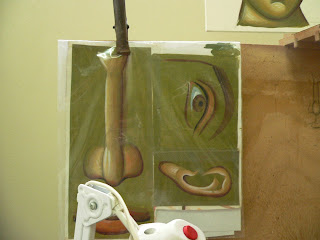
I, in turn, absorbed the images around me, asking her questions about the process of tracing her images onto the panels rather than drawing, and looking carefully at the different tools and aids she had created to help her learn the "alphabet" of icon painting. One thing in particular, a large schemata of an eye, a set of lips, an ear, and a nose I
thought was most interesting.
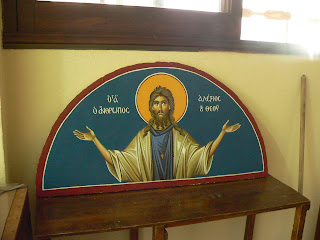
We discovered that neither of us care for the highly-polished gold ground made with red clay bole, preferring rather the gold leaf put on with glue. And both of us have dabbled in some fresco, she more than I. She showed me a very unusual material she'd used to create a beautiful fresco of St. John the Forerunner. It looks like dried grass all compressed together, and must be some sort of recycled wood or paper product. It is very porous and both light and
strong. I've never seen anything like it. She offered me a huge piece to take home and I laughed to think of what the Customs officials would say. She cut it down for me.
We also discussed books and brushes. She gets her brushes from Germany, so I knew I had nothing to offer her in that respect. Some of the brushes I use are also from Germany and the Daniel Smith Autograph series I told her about which is produced locally in Seattle she already knew of and has a catalogue for them. In terms of books, her shelf looked awfully familiar, and some of the Russian volumes she pulled out are among my top 5 favorites. The wonderful productions of Panselinos and Theophanes the Cretan I already have, and she showed me a few key others to consider from Greece.
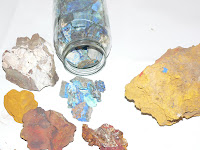
She was very excited to show me something else, and I was most amazed. She opened a cupboard to reveal a large pile of variously-colored stones. "Here is ochre," she said. And it certainly was! Another of red ochre, another stone with a band of white and a glass jar filled with smaller rocks boasting stripes and crevices of bursting blues: malachite, cerulean, aquamarine. She told me that the hills here are extremely mineral-rich and that they mine and grind their own pigments, using a local miner as a guide. They have found many of the stones containing blue minerals, which are very rare and costly. She gave me one to take home. I can only imagine how difficult it must be to pulverize these rocks into pigment. She showed me photos of them with safety glasses and gloves, working away at the grinding. She also said they used many of these in the frescoes in the church, and that they discovered with the blue stones that if they grind them smaller, the color becomes lighter. She showed me a photo of the Panaghia's blue robe and pointed out the darker areas with larger grind and the lighter areas with smaller grind. She said they used no white to lighter the color, just adjusted the grind. Fascinating.
I was sorry to have to leave the studio, although I'd had a good half hour there. Basil was becoming restless and we needed to pack up our things and head on our way. The rental car needed to be returned before 2PM. I was most grateful to have this opportunity at the end of our stay, though. Sister Theangeli and I agreed to keep in touch and help each other out. She offered to procure images for me when I'm having trouble finding a prototype, particularly of an obscure saint. And I promised to send her some information and photos on the Russian style of painting. On my way out, I admired the striking St. John the Forerunner fresco that she did.
We were all saddened to leave Lavrio. The sisters had been very hospitable and kind. They almost all spoke English, and it was easy to communicate with them. We felt at home there. We relaxed and eased into the rhythm of their life a bit. Emma was a bit weepy as we were accompanied down by sisters Theophani and Theoctiste, with whom we had spent most of our time. They urged us to come back again, asking Emma particularly if she would. She had said the night before that she wants to return to Zakynthos and to Lavrio. In these places, she has really been touched by the sisters and their life and love for her. I am most thankful.
And we are off... heading back towards Athens!
A Little Rhythm
The bell tolled next morning for prayers at 5AM, followed by the mellow sound of the talendron beating out its invitation.
 I rolled over and slept some more. Yet I managed to get up an hour later and still be there for a good hour and a half of morning Orthros, greeting the mosaic of St. Paul over the door as I walked in. I stood at the same chair and listened to the sweet chanting of the handful of sisters. The time of quiet prayer refreshed my soul.
Afterwards, Grandma, Basil and I gathered at the table for breakfast at 8:30. Theophani brought us hot water for our Nescafe, a carafe of fresh milk, hard-boiled eggs, bread, butter and homemade apple marmalade, their organic feta cheese, and some cookies and sour cherry juice, which we really love.

She showed me the little kitchen next to the trapeza where we could wash up our things afterwards.
I asked her if there was some work we could do that day. She had
suggested that we may want to drive over to Lavrio, near which there were two interesting things: some garments and other secondary relics of St. Nektarios and the legendary cliff from which King Aegeus had jumped in grief over the mistakenly supposed death of his son Theseus, thus giving its name to the Aegean Sea. Emma and I were very familiar with this bit of mythology and I had been torn, wanting to see this cliff but also wishing to stay put here in the monastery for our one day there. Emma's lack of interest in seeing "just another cliff" made up my mind. Theophani said she had some nuts we could crack for them. And so we spent the day with the rhythm of the monastery, which was wonderful.
Basil was completely content all day long with his trucks as Grandma, Emma and I struggled over those nuts for about 4 hours. Grandma made a lot of headway with the walnuts. I, on the other hand, have a much greater appreciation for almonds than I ever have before. I found the nutcracker completely useless against the incredibly hard shell of the almond. I got through a few with the mallet,

but many more were impermeable and went flying in all directions, like little almond bullets, when the hammer slammed down on them. I was afraid I'd injure one of us, so I turned to the pecans, which were done in no time with their thin, brittle shells. Emma was having a great time throwing her walnuts on the ground to crack them.
We talked about the book Grandma had picked up from my table: Beginning to Pray by Anthony Bloom. Over the day or two there she read the whole th
ing. We talked about prayer. She talked about what prayer had been and meant in her life, not so much an ascetic practice as Fr. Anthony described with the Jesus Prayer, but more of a constant remembrance of God throughout her life, an awareness of His presence and a solid faith in Him that she has never felt needed to be tested or unduly examined. I had to agree with her that this is the kind of thing Orthodox prayer is moving towards in its discipline, too. At the end, it is the remembrance of God that we seek.
Grandma articulated the basic experience of that very well. For her, this is and has been her own faith and the unfolding of religious belief throughout her life. As most of us know, remembrance of God is often not something easy, and not to be taken for granted. But some seem to have been given the gift of faith, or this foundational remembrance of and belief in God, which comes to them almost effortlessly. Most of my own life I've recognized

this as well, with only a few times of struggle or doubt that passed relatively quickly. Perhaps this "gift of faith" is one of the greatest things I've inherited from my mother, something that has permeated and given shape to my whole life.
I tried to explain, not having really experienced it much myself, the deeper understanding of remembrance of God that Fr. Anthony is referring to in his book, the kind of remembrance that the saints seek, who spend their lives in interior pilgrimages much more arduous than what we have endured, just for a taste of that blessed awareness. I talked to her about the energies of God, the hesychastic way of prayer that is both an art and science for Orthodox Christians, and one that we all must try to embrace to the degree we are able. I told her about how those who reach a state of illumination, who are blessed with the constant remembrance of God not only in their subconscious, but in their conscious minds as well, about how the very bones of these holy ones are changed and transformed. We've seen this. We've smelled the fragrance from the relics and touched the myrrh-soaked squares of cotton from the miraculous icons.
For me, it is hard to just sit myself down in silence and attend to prayer. Services are much easier, with singing, rubrics, and many words to try and absorb. But practicing the Jesus Prayer, for me, has been a slow effort of fits and starts. At times, I build a rhythm and consistency, when the prayer becomes sweet to my mind and heart, and even an effortlessness can attend me sometimes. And then at other times I let go of that "thread" or habit of prayer and allow myself to be distracted again by the concerns and indulgences of the world around me, dropping a consistent habit of practicing the Prayer altogether.
If I sit down for a time of prayer, my second challenge is always keeping my mind focussed on Christ, keeping it away from the awareness of myself and all my questions, thoughts and self-imposed conundrums. It is a constant effort to re-focus my awareness on God. I realize how difficult it is for me to truly remember Him and sit before Him and in Him quietly without distraction.
One of the nuns from America, Sister Theodicte, came and told me they were starting prayers: Hours, Paraklesis, and Vespers. With some major repairs going on in the monastery, the normal prayer routine was being changed. More physical manpower was needed to help with the work and both Compline and Orthros the next day would be held in the monastery chapel rather than the main one accessible to us. She invited me to join them in a small chapel to the Archangels for this afternoon prayer service, however.
It was just Sister Theodicte, another woman who had obviously been there some time and taken on a rule of participating in some of the prayers, and myself. The chapel was quite new, it appeared to me. I was very surprised to hear the words: "Have mercy on me, O God, according to Thy great mercy..." in English! She read several more prayers throughout my hour there in the mother tongue we shared. It was interesting to hear the other woman praying the Trisagion in Greek. Even as such a novice in that language, I could hear a very unusual accent, probably due to her Asian, maybe Japanese, background.
We were brought a tasty lunch at about 2PM: fried potatoes, a large Greek salad sans cucumbers with small feta cubes, peppery red onions and dark purple nicoise olives, some bread, and a sweet walnut cake infused with honey syrup. After all the nut cracking, which Grandma valiantly finished even after the rest of us gave up, it was nice to taste a little of the "fruits" of our labors.
The heat was rising again, and that familiar sticky feeling descended on us. We all went back to the room for a siesta and actually fell asleep. When we woke, it was cooler. I took Emma downstairs to search for the kitties and to collect our bags from the car so that we could re-pack a bit before our departure the next day. Later in the afternoon, Theophani again brought us a huge plate of watermelon and stopped to sit and talk with us for awhile. A few other nuns had passed by to chat throughout the day. Sister Theoctiste told us of how she had come from the Midwest twelve years ago, drawn by hearing someone from this area give a lecture in Pennsylvania. Her heart stirred, she came and stayed. Sister Theangeli was from Germany.
In fact, one of the things that marks this particular monastery and the sister monastery of St. John the Forerunner on Mt. Ossa, near Volos, is it's international community. There are sisters from Greece, Bulgaria, Germany, Japan, England, Russia, and America. And probably some other places I don't remember. As I told them, it reminds me of Elder Sophrony's monastery in Essex. Sister Theoctiste told me that they often use a variety of languages in their common prayers.
Although I understood that St. Paul's in Lavrio was Elder Dositheos' first establishment, the proximity of the newly-sprouted town of Plaka and the general growth in that area, just a 40 minute drive from Athens, pushed them to establish a second monastery in the more remote Mt. Ossa. They had finally moved all the animals that used to be here up there, where they had more space and less activity from outside. The establishment there is much larger, from what I gather, with maybe 20 or 30 nuns instead of the 6 or 8 here. They are working toward running an extensive farm there, with organic produce as well as homemade feta, marmalades, herbs, and other products from their own livestock and gardens. The two monasteries work closely together as one, shifting sisters back and forth as needed. Apparently the main port of Pireus which serves Athens will eventually be closed and replaced with a huge port already under construction out of Lavrio. This will certainly increase the traffic more at St. Paul's. Sister Theophani sighed as she told me this, but then said, "But God knows." In many respects, this smaller monastery nearer the centers of commerce is easier for people like us to make it to, for spiritual refreshment. I'm glad it's here.
I went to the church and took photos of all the icons, then worked on drawing as the sun went slowly down. Grandma read her book, Basil played and Emma chased bugs and other critters, then found a mama kitty behind the church with a tiny mewing calico. Most of the rest of her efforts throughout the evening consisted in ferrying bits of food to her.
Theangeli asked if I would like to see the icon studio later. Unfortunately, their work didn't allow her to get back to me, so I contented myself with more drawings, something I'd had little time to pursue throughout our trip. As we went up to our room for the night, I saw a perfect full moon, as if suspended in the mellowing blue dusky sky. Beside the bell hanging in one of the archways above our bannister, it seemed to betoken the utter sense of peace and deep tranquility here.

Tuesday, July 22, 2008
Monastery Agios Pavlos, Lavrio
After our most dramatic adventure in and out of Volos, stopping at the stunning monastery of Taxiarhadon and having to leave it for lack of lodgings, our unexpected overnight in Almyra wrought some wonderful fruit for us. As I mentioned, Fr. Ioannikios was our "knight in shining armor" and one of his parishioners, Katerina, was a wonderful translator between us. They were very hospitable and most kind, arranging our next steps for us.


 stood on a few slabs of stone with an open censer beside it. This was the grave of their elder Dositheos, who had passed away about a year ago. Theophani told me he had been instrumental in cleaning up Meteora as well as establishing their monastery here in Lavrio.

 tier above had St. Thomas at the door on the right and Pentecost on the left, covering half of the vault. The half closest to the altar contained a gorgeous icon of the Ascension which spread across the vault in an arc: on the left, the Apostles and Virgin in orans position; above, Christ ascending in a blue orb flanked by angels; on the right, the choir of angels with arms upraised. It was magnificent.
Katerina told me that this was the metropolis, or cathedral church in the town, and that Fr. Ioannikios had directed its establishment and building, taking care for everything from the iconographic program to the potted plants outside. She spoke with great love and devotion of his life among them, and his many labors for the parish. She told me he is a monastic priest, and that he has a brother priest and a sister abbess. He had a full gray beard, pony tail, and a rich, broad smile. I left him with a bottle of lampada oil from St. John Maximovich and he was very excited about it.
We left Almyra heading south towards Athens. For some reason, I got the impressi
on that Lavrio was pretty close to the city. Our directions were very simple getting from one freeway to another in Athens and then as we got closer to Lavrio just stopping to ask locals for directions to the monastery. We also had their phone number.
Of course we missed the first exit, not realizing it until we had passed under it. As usual, it took me long enough to decipher the Greek instructions that we missed our chance to exit. Getting off and going around the other direction was not nearly so easy as one would i
magine it to be, and in fact, we opted to follow some guy's instructions to drive down into town and through it to Attica. I really ought to have consulted a map, to realize how far Lavrio is from the city center. Instead, I just went with what he said.
The result was that we ended up driving into downtown Athens and wasting a good solid hour until we found a wonderful guy who actually consulted a serious street map and gave us perfect instructions for maneuvering our way through the city to the old freeway we'd originally left so that we could carry on the same instructions we were given in the first place, taking Marcopoulo out of town and down the finger of a penninsula toward Cape Sounio.
At long last we had left the city quite far behind us and pulled over in a small town that Fr. Ioanikios had mentioned. From here we called the monastery for directions. I had left Grandma and the kids in the car, pulling up in front of a flower shop in a square that had obviously been temporarily converted into a parking lot to accommodate a funeral at the large church across the square. Poor Grandma got cussed out in Greek by the shop owner. A pretty unpleasant experience to have someone yelling at you in a language you don't understand. But funny, if you consider it properly.
Before long, we were exiting the freeway and slowly climbing a small hill, quite unsure of being in the right. Thankfully, a local woman appeared out of the sleepy village ahead and assured us the monastery was straight ahead, on the other side of the hill town of Plaka. It looked to
contain a good handful of homes and a taverna or two.
We found the posted sign to the monastery and were so relieved that they were actually expecting us. We drove up and down a small dirt road that completely concealed the monastery. No church dome or building was visible at all, which seemed quite strange to us. But the big black gate embedded in a tall white-washed wall and crowned with a cro
ss was unmistakable, and we saw buildings rising behind it through the leaves of large trees. We drove around to the back where there was room to leave the car and walked back to the gate. Happily, there was a bell, which we rang.
Within a minute or two, our primary host, Sister Theophani opened the black gate and warmly greeted us, hugging Emilia to her and kissing her head, and picking up Basil, greeting Grandma and I enthusiastically. We went and got a few bags as she took the children inside the small
chainlink gate across from the monastery door where the kids delighted in a very friendly
kitten.
She apologized for all the stairs, but we assured her nothing could compare to our hike down and up at Aghia Triada in Meteora. St. Paul's is built into the side of a steep hill and has a very vertical-horizontal feel to it. The initial staircase led up to the main level where the church stands as well as a chapel and graveyard to the far right and the monastic enclosure to the far left.
Another staircase brings one to the next level with a passageway across to the nun's quarters on
the left behind the church walls, a lovely outdoor trapeza in the middle with a simple roof and vines overhead and a small children's playground on the far right. One more staircase up leads to another chapel on the right and a fourth staircase up to a large building for pilgrims on the left. We followed Theophani and the children down a long corridor with a rail on one side overlooking the church and offering a sweeping view out over the monastery towards the Aegean. An oddly conical small mountain lay slightly left between us and the water, and rolling hills towards the right showed the way we had driven up. The town of Lavrio fanned out around the sea, with white-washed homes huddling together, and a hook of land jutted out into the blue sea beyond.
All around us were green and growing things: pines dripping sap, bright red geraniums, roses, potted broadleaf plants, oleander, jasmine, ivy. The air was coolish and very comfortable. Theophani told us that their elder built this monastery 30 years ago in what was the
n a remote pine forest. Now the homes of Plaka came right up to monastery property and we could hear dogs barking and children playing.
We settled into our room with 3 single beds on either side, separated by a bathroom and the door in the middle. The mothball smell was so strong you could practically taste it. But
the room was sweet, made sweeter still by their attention to us as guests. Four glasses stood atop four napkins, perfectly folded in triangles. A large thermos of very cold water sat beside a
tray holding 2 bowls of candies and a tub with biscotti-like cookies and four foil-wrapped chocolates. The walls were adorned with lovely icon prints and each room had an electric fan. Grandma was a little shocked to find that the "shower" was simply a hand-held shower head attached to the sink. Presumably one used it right over the drain in the middle of the bathroom floor. I explained to her that this isn't uncommon in monasteries, probably, as many follow a rule of little washing. I was surprised we had a mirror. That's another thing often absent.
Theophani left us to settle in a bit. First off Basil and Emma wanted to explore the playground, so we all went down to the level below. Filled with dry dirt, plastic trucks, pots and pans, and pine needles, it was Basil's idea of paradise. And Emma enjoyed testing out all the swings. In fact, they were both happier and more carefree than I'd seen them in awhile. I noticed down below the playground that they had a graveyard, a common site in monasteries. There were 8 plots, most of them just body-long rectangles of turned earth filled with gravel and edged with white-washed stones, and a simple single-name label on a wooden sign. One grave, however, was covered with many plants and vines. A small oil lamp, enclosed in a six-sided glass lantern,
stood on a few slabs of stone with an open censer beside it. This was the grave of their elder Dositheos, who had passed away about a year ago. Theophani told me he had been instrumental in cleaning up Meteora as well as establishing their monastery here in Lavrio.Soon, Theophani brought us a large plate full of watermelon, sweet, cool, refreshing. We ate every last piece. The children, dripping with juice, ran to get covered again in dust as we sat talking to her for a long time at the table. Nearing the end of our journey, Grandma and I both were beginning to try and put our experience into words, to create a frame for what we had seen and done, to encapsulate it, in some way. She talked more freely now than she had in most monasteries and churches during our trip. It was easier, in this place of simple hospitality, with a nun who spoke perfect English and took the time to sit with us.
At one point, Theophani asked us if we had liked Greece, and Grandma said she would be relieved to return home and step again onto "good old US soil" in a few days. I completely understood her answer. This has been a gruelling trip, at times, for all of us, and a tiring trip much of the rest of the time. Grandma has been a stalwart trooper, despite her 74 years, making it through gallons of sweat, layers of grime, alien bathroom receptacles, food she could care less about, constant gibberish, exhilarating driving techniques, and a steady
stream of foreign religion, with almost no complaint. She's been a tremendous help in many ways and a much-appreciated companion for all of us.
Yet I think the timing of the comment coupled with a lack of context, struck a chord in Theophani. She answered, "Oh, I see," with a slightly-raised eyebrow. What ensued was a lengthy conversation about the differences between America and Greece. In some ways, her sense of patriotism and her willingness to speak to us from the "heart" of the Greek people opened history to me in a way reading a book cannot.
"Americans have not suffered war. They bring war to other places, but have not suffered it on their own lands. How can you understand how it has been for us?" She went on to tell us about the various occupations Greece has suffered over the last several hundreds years: the Venetians, the Germans, the Turks, each one taking away freedoms, resources, cultural identity, sometimes even language and religion. She talked about what an effort it has taken for them to recover, to re-build basic resources throughout the country like the National
Highway. Other wealthy countries may consider this highway sub-standard as a National road, but it has taken them much effort, and is an achievement of which they are very proud. She spoke about the millions of refugees that have flooded Greece over the last few years from places like Albania, Serbia, Pakistan, largely fallout from military ventures by the US. She didn't speak with bitterness, but she did speak with a certain severity. These are their experiences.
I told her that one of the striking things to me, apart from the multitude of relics and churches all over Greece, was the way life still centers around local agriculture, with small farms dotting the landscape all over, and the very social nature of their daily lives. People go to the bread shop, the butcher shop, the fish shop and vegetable stand, probably in many cases daily for their needs. There are some supermarkets, but only in larger cities and gas stations. And the plazas, streets, and cafes are bristling with life every evening. The old men sit at their ouzos or cafefrappes together watching the world pass throughout the bulk of the day. Women chatter as they pick out their eggplants and nectarines, young people gather at the internet cafe, sit on the side of the fountain, or gossip over gyros. They all convene together at the churches and monasteries, flowing through like an unfailing river running its well-worn course.
She took us to see the church. Although relatively newly-built, they purposefully constructed it on the pattern of older churches. A basic cruciform plan, with chant stands on either side. The barrel vault and
apse above the altar embrace lovely paintings, newly executed. Theophani told me that the dome and apse are true fresco, whereas the other paintings are secco, literally, "dry-wall", meaning that the paintings, executed in any media, are painted on or attached to a dry wall. I hadn't realized until talking with Fr. Ioannikios that the vast majority of new wall-painting in Greece is not fresco, but secco. He mentioned Lavrio as one of the places where I would be able to see some new fresco, and here it was.
The style was very traditional, with a deep blue ground behind the simple enthroned Virgin in the apse, and the strong-faced Pantokrator in the dome, edged thinly in white and a band of intense red ochre. The Virgin's robe looked almost luminescent, with an undertone of red gilded by an almost metallic blue.
On the lowest level of the vault, the left side held the Trinity and the right, a short series of Moses, receiving the tablet of Commandments, and standing before the burning bush, a striking design – the Theotokos and Child within a blue mandorla cradled by the bush's leaves. The
tier above had St. Thomas at the door on the right and Pentecost on the left, covering half of the vault. The half closest to the altar contained a gorgeous icon of the Ascension which spread across the vault in an arc: on the left, the Apostles and Virgin in orans position; above, Christ ascending in a blue orb flanked by angels; on the right, the choir of angels with arms upraised. It was magnificent.Grandma and the children retired to our room as the bell tolled for Compline and I went to the church. I leaned into a wooden chair right near the door and fingered my compeskini, praying for myself and everyone I could remember as the evening worship flowed quietly around me and through me. I left early, worried about how they were faring above, and ready for sleep myself. It was a comfortable night. Twice as we were getting into bed, one of the nuns came to bring us one more thing: a nightlight, the offer of a "torch" (flashlight) to make it down for prayers the next morning if I wanted to. We were well-cared-for and fell easily into reviving slumber.
Wednesday, July 16, 2008
An answered Prayer
The next morning as everone slept, exhausted from our vigil on the road, I got up and headed down the street to St. Demetrios church. Too late for taking communion, but the huge church was beautiful, full of faithful, fully decorated with icons. I prayed a few moments, lit a candle, and stood quietly looking at the icons. There was St. Emilia! The first time I've ever seen her in a church.
I went back home, hoping the kids were up and could come take communion. Nope, both still sleeping. But Grandma was up and I told her I'd go to the other church then come back. I went down the street the opposite way and came to Agios Nikolaos. This was equally large and majestic, obviously a relatively new church, and also fully decorated with even better icons. This was a real master iconographer. Which church should I bring the kids back to? Grandma was already letting me know she didn't want another night like that and we should just count on getting a hotel early in the day. I wanted to keep room for finding a monastery if we possibly could, and thought I would ask a priest. But which church should we go to?
Of course, we went back to St. Demetrius because of the St. Emilia icon, which Emma had to see. Although I felt wrong doing it, in a way, I snuck the kids in the side chapel behind several Greek mamas bringing their children late -- very late-- like, Liturgy is completely over late -- to have communion. The priest didn't bat an eye.
We went up to get a blessing from the main priest, and when I asked if he spoke English, he said that he lived in Ohio! Fr. Ioannikios ended up taking us downstairs to his office, filling us with cupcakes, and calling a monastery in Lavrio (outside Athens about 45 minutes) and securing a blessing from the Gerondissa for us to stay there for 2 nights. Thank God!
I will have to write later about our experience there, but it was all I had hoped for. We have spent last night (Tuesday) in Athens with Maria and Nikos and will be here again tonight. Our time with them has been wonderful. We fly home tomorrow morning. I will have to tell the final tales either en route or after we are home.
Macrina signing off in a very warm Athens at 4:30PM. I've spent all the money I had on icon books and pigments and am a very happy clam!! I think Grandma will be most relived to get back on US soil, but we will all be happy to be home again, even though Emma and I would stay another month if we could!
I went back home, hoping the kids were up and could come take communion. Nope, both still sleeping. But Grandma was up and I told her I'd go to the other church then come back. I went down the street the opposite way and came to Agios Nikolaos. This was equally large and majestic, obviously a relatively new church, and also fully decorated with even better icons. This was a real master iconographer. Which church should I bring the kids back to? Grandma was already letting me know she didn't want another night like that and we should just count on getting a hotel early in the day. I wanted to keep room for finding a monastery if we possibly could, and thought I would ask a priest. But which church should we go to?
Of course, we went back to St. Demetrius because of the St. Emilia icon, which Emma had to see. Although I felt wrong doing it, in a way, I snuck the kids in the side chapel behind several Greek mamas bringing their children late -- very late-- like, Liturgy is completely over late -- to have communion. The priest didn't bat an eye.
We went up to get a blessing from the main priest, and when I asked if he spoke English, he said that he lived in Ohio! Fr. Ioannikios ended up taking us downstairs to his office, filling us with cupcakes, and calling a monastery in Lavrio (outside Athens about 45 minutes) and securing a blessing from the Gerondissa for us to stay there for 2 nights. Thank God!
I will have to write later about our experience there, but it was all I had hoped for. We have spent last night (Tuesday) in Athens with Maria and Nikos and will be here again tonight. Our time with them has been wonderful. We fly home tomorrow morning. I will have to tell the final tales either en route or after we are home.
Macrina signing off in a very warm Athens at 4:30PM. I've spent all the money I had on icon books and pigments and am a very happy clam!! I think Grandma will be most relived to get back on US soil, but we will all be happy to be home again, even though Emma and I would stay another month if we could!
Subscribe to:
Posts (Atom)